

This piece continues a story begun in “By Parties Unknown.” If you missed that essay, you can find it by clicking here. Thanks for reading!
“By the way,” wrote Sam Perlman, son of Jimmie Lee Cochran’s employer in Hurtsboro, Alabama. “My mother wrote a book on our family history … She devotes about two pages to Jimmie Lee.”

I almost fell out of my chair. Since Sam first messaged me that he remembered the story of Mary Darian’s father being forced out of his home town, we’d mostly chatted about his memories of growing up in Hurtsboro. “I could not have had a better childhood,” he’d written. Though he acknowledged in retrospect Hurtsboro’s racial tensions and inequalities, he recalled an idyllic way of life—waking on Saturday mornings “to the sound of horse drawn wagons filled with cotton as their wooden wheels rolled on the concrete roads” en route to the town’s cotton gins; playing baseball every day with his best friend who lived two doors down. In some ways, Sam echoed Mary Darian’s feelings about her eastern Alabama years. She, too, sometimes waxed nostalgic about her childhood. Thanks to the strong women who raised her, she thrived within the borders of the simple life they provided. She longed to smell her great-grandmother’s biscuits cooking on the pot-bellied stove, to taste again the fruits and vegetables grown in the family garden. If not for the dangers and inhumanities she faced as the daughter of a poor sharecropper, it would have been a fine place to grow up.
But here, in an email weeks later, Sam announced there was a written record of Jimmie Lee’s banishment. This was more than I’d hoped for! Within hours, a copy of the promised pages from his mother’s “A Family History” landed in my inbox. After Sam’s father Sol Perlman died when he and his sister were teenagers, his mother, Bertha, ran H. Perlman and Sons herself, both the Dry Goods store and the Five and Ten (remember those?). She later remarried and in 1985, at seventy-four years old, wrote her family history. A remarkable woman, she had a copy of this history catalogued and registered in the Library of Congress.
“The name of the fine black man who helped Harry was Jimmie Lee …” Bertha begins. “On Saturdays, he would help in the store, bring merchandise from our building across the street, sweep floors, and do odd jobs …”
Perfect. I was meeting Harry, Sam’s uncle and Sol’s brother and partner, for the first time, but otherwise this aligned with what Mary had said about her father, that in addition to working the cotton fields, he chauffeured and did maintenance work for the Perlmans and the Goldsteins, their friendly competitors who owned other Hurtsboro stores. Thanks to these side jobs, Mary had added, “our mother could stay out of the fields and take care of us.”
“We always had extra clerks on Saturdays and sometimes during the week … especially in the Fall,” Bertha continued. “One of these clerks was a girl we hired when we first opened our five and ten cent store. She clerked for us full-time until summer when business was very slow. Since she was the last clerk we hired, we told her that we would not need her through the summer months, but when Fall came around we would be glad to rehire her. This was the understanding even before she was hired, and she seemed to be satisfied and left in a very friendly mood, and we thought nothing of it after she left.”
I was hooked. Bertha (full byline Bertha Perlman Sitkin) was a good writer. She sets the scene and gives the facts—it was summer, business was slow in the five and ten store the Perlmans had recently opened, and because of this, they furloughed an employee until fall. But her language foreshadows trouble. My palms began to sweat.
“We kept Jimmie Lee, our porter, for we really needed him … One Saturday, I had Jimmie Lee drive me home for a little while. He was on the highway back when five men from the town stopped him. Among these men was the cousin of the clerk we had let go for the summer. They pulled him out of the car and began beating him and told him he was getting too biggity.
So here was the crux of it, such a familiar crux. Through no fault of his own—to the contrary, because he did his job well—Mary’s father was hunted down, five-on-one, and blamed for a white girl’s distress, at this time an unforgivable offense. During the 20th century, Black men were routinely punished, or worse, for being biggity, uppity, as if their very industriousness and ambition were a crime (which was tricky—not working hard might mean being labelled shiftless). The surprising thing about Jimmie Lee’s situation is that he wasn’t accused of something worse, that these men didn’t fabricate an assault of the young clerk by way of inciting a larger mob to track him down. Then again, maybe they did. We’ll never know, and it hardly mattered. Their intentions were much the same.
“They warned him that if he didn’t get out of town, they would kill him. Jimmie Lee got back into the car, but instead of going back to the store, he was afraid and went home. When I called for him to come and pick me up … Sol answered the phone and said that Jimmie had never gotten back … We just couldn’t imagine what had happened, for it wasn’t like Jimmie to do something like this. Finally, in about an hour, Jimmie Lee’s grandmother came into the store with tears in her eyes. She took us to the back of the store where no one could hear, and told us what had happened, and would we please get Jimmie away from Hurtsboro.”
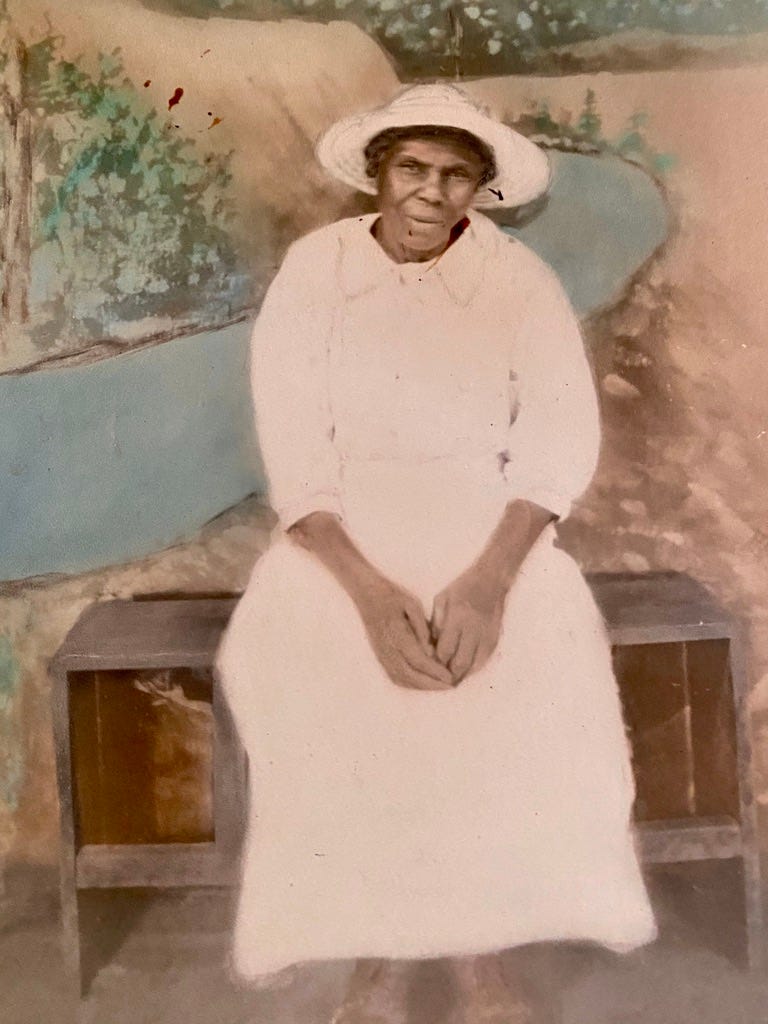
This, that Mary’s great-grandmother took action on behalf of her grandson, was the least surprising part of Bertha’s narrative. Caroline Walker, Grandma Ca-line to Mary, was the rock of Mary’s family. In my last post, I mentioned how risky it was in the pre-Civil Rights era for anyone, family member or stranger, to single out those who threatened a person of color, much less report them to the authorities. But Caroline, a bone poor woman in her late sixties, refused to stand by. The notion of losing her grandson for good was more frightening than any harm she might bring on herself.
“The first thing which entered our minds,” Bertha wrote on. “Was Lillian’s father, who was in the meat packing business. I don’t remember how we got in touch with him, but the next day, Sunday, we picked up Jimmie Lee to take him to the bus in Columbus headed for Atlanta. It was night, and Jimmie hid in the gutter near his house. We turned off our lights. Jimmie had a very small flashlight. When we saw the flash of the light, we knew it was him and picked him up.”
I paused, a vivid and terrible image in my mind: Mary’s father, bruised, perhaps bloodied, sweating in a gutter in the Alabama heat, his dreams of a future, any future, held in the tiny flashlight that was his signal fire. Mary’s family lived on the Columbus highway near the town railroad tracks, their home exposed to all who cared to find them. But the Perlmans, likely with Abe Goldstein, too, acted fast, and their plan worked. Once Jimmie Lee was hidden away in his rescuers’ car, living on the highway was a good thing. The bus station in Columbus was a straight shot thirty miles across the Georgia line. From there, Jimmie Lee, who must have seen the faces of the men who’d beat him in every passenger and bus employee, was on his way to safe harbor and a good job thanks to Lillian Perlman, Harry’s Atlanta-born wife, whose father owned a meat-packing business.
“He had to leave his wife and two babies,” Bertha concluded. “But he had a good job waiting for him. Lillian’s father was so pleased to have such a good worker, so it wasn’t long before Jimmie sent for his family. The last we heard about him, which was years ago, is that he had gone to school and become a mail carrier.”
Here Bertha misrepresents an important detail—understandable considering she was describing an event nearly fifty years in the past. Seven or eight years would pass before Jimmie Lee felt safe and stable enough to “send for his family.” For a young girl growing up without her father, that “short while” must have felt like decades.
Even with Bertha Sitkins’ brave account, it’s hard to pinpoint in time Mary’s family’s terrifying ordeal. We know it was summer. We know Mary was too young to remember. Now hopeful of learning more, I returned to Ancestry. Though the city directories I searched were a dead end, censuses, as usual, proved helpful. In the census taken in April, 1940, Mary’s father is not listed as part of Caroline Walker’s Hurtsboro household, but a Jimmie Cochran is listed on Pulliam Street in Atlanta. Bingo. Mary remembered this street, her father’s first Atlanta address.
Bertha Sitkin wrote that Jimmie Lee left behind “two babies.” Could be she forgot about Mary’s baby sister. Who knows. But if she remembered correctly, Jimmie Lee’s exodus would have occurred after the birth of Mary’s younger brother but before her sister arrived in August of 1938. For obvious reasons, Jimmie Lee would have been in town the previous fall, meaning that Mary’s father was likely forced out of town in early summer, 1938, when Mary was a few months shy of three, her brother Leroy not yet two, and her mother was about six months pregnant with her third child, Charlene Cochran.
The men who attacked Jimmie Lee went free, unnamed, their deadliest goal averted.
“My uncle on my mother’s side …” Mary said, filling me in. “Hid Daddy when he got to Atlanta. He got a bicycle so he could get to work. One day a man driving by hit him.”
I flinched. Grinning, Mary passed a hand across her face as if to dismiss my worry. Her father wasn’t badly hurt, and it turned out the car’s driver worked in a high position for White Provisions, an Atlanta food supply company. Jimmie Lee impressed the man, and he was offered a job in the kitchen, one that paid better than the meat-packing gig.
“And it was a funny thing,” Mary went on, pride in her voice. “Sales at White Provisions had been dropping on their sausage. Daddy told the cook he remembered a recipe from his grandmother, and the cook let him try it. The man in charge tasted it and asked who made it. ‘The new fella,’ the cook told him. ‘Well,’ the boss said. ‘Tell him he won’t need that bicycle much longer.’”
Gritty and resilient, Jimmie Lee escaped the death sentence thousands like him could not, and made the most of it. As his new employer had predicted, he saved to buy a car, and eventually earned enough to support his young family. He would take another job with the post office and later worked for Southern Railway, where he built a career that lasted thirty-three years. “Most folks don’t last thirty-three days!” Mary told me, her eyes glazed with tears.
“It seems [Jimmie Lee] probably had a better and more complete life than he might have had in Hurtsboro,” Sam Perlman wrote of Jimmie Lee’s accomplishments. He spoke the truth. If that young clerk hadn’t been released from her job at Perlman and Sons, inciting her cousin to come after Jimmie Lee, the Cochrans might never have left rural Alabama. What befell Mary’s father was monstrous, but in Atlanta his children attended better schools and found better opportunities than they had back home. This story thus ends with an ironic twist: Jimmie Lee’s assailants gave Mary’s family a gift, if one forged in anguish, the gift of starting anew.
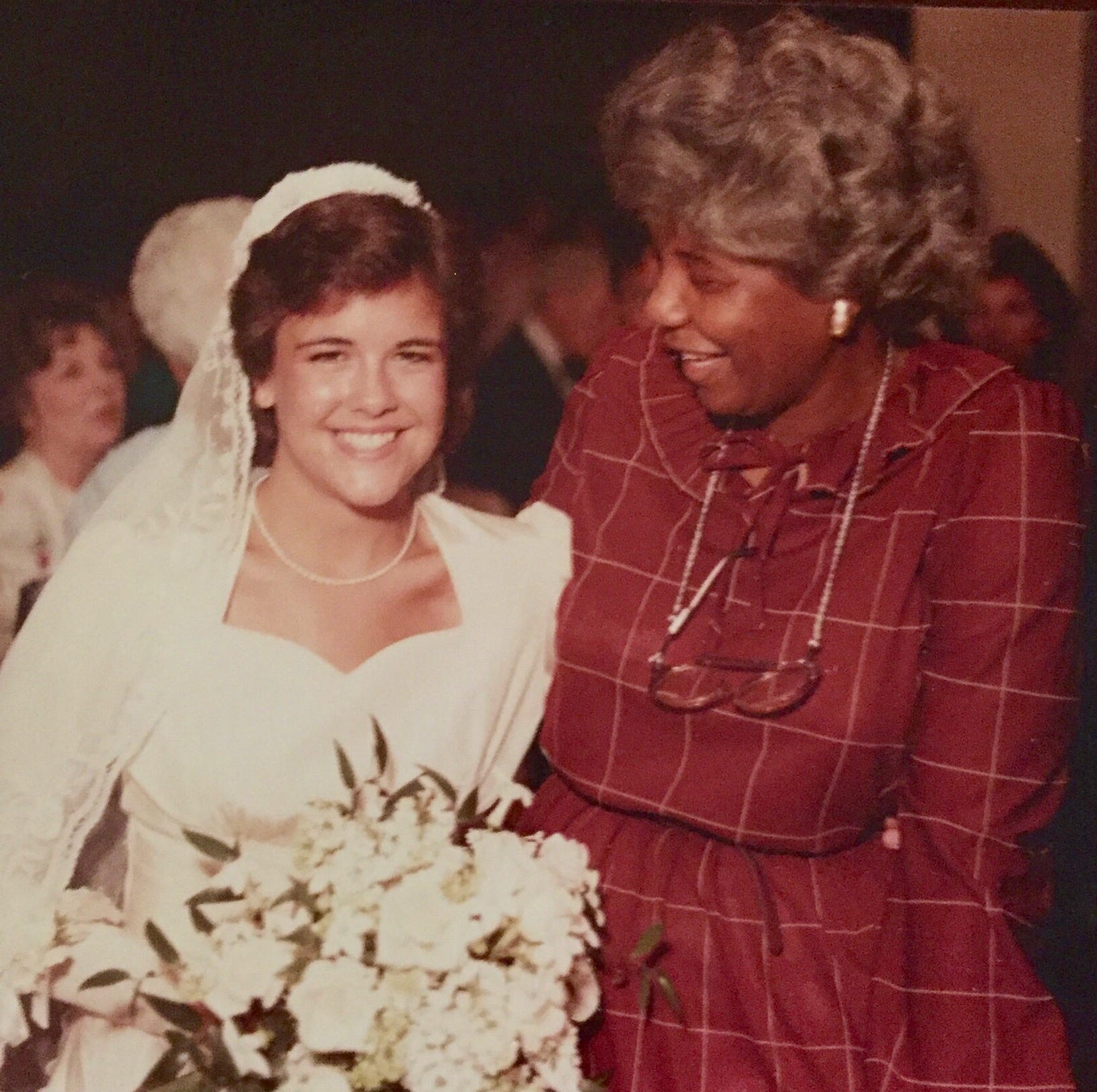
When Mary was eighteen, a new bride, my mother had four young children and one on the way. She heard through the grapevine that a cheerful, capable young woman was looking for a job. Before long she, like the rest of us, fell in love with Mary. The painful, winding means by which she ended up in Atlanta was unforgivable, but my siblings and I are forever grateful that Mary’s path led to us.
My posts are free, but I’m very grateful for my paid subscribers, whose generosity helps support my writing and publishing efforts. If a paid subscription isn’t your thing, but you’d like to make a small, one-time donation, just click here. Above all, thanks for pausing your day to give me a read.
Another great piece!